How generative assistants and plugin ecosystems are reshaping content discoverability
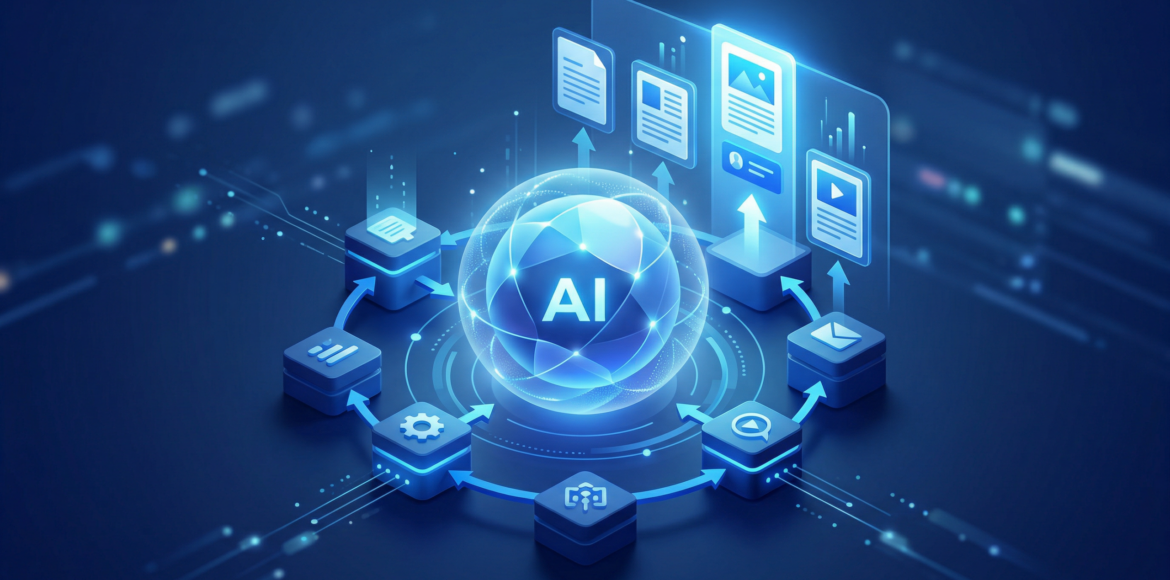
Content discoverability is being rebuilt in real time. For years, marketers could treat search rankings, paid distribution, and on-site conversion paths as the core levers of digital visibility. That model is now under pressure from generative assistants that answer questions directly, summarize options before a click happens, and increasingly keep users inside the interface. In practical terms, the assistant is becoming the new front page for discovery.
This shift matters because it changes what visibility actually means. It is no longer enough to rank well on a results page if the user never reaches that page, never scrolls to your link, or gets a synthesized answer without visiting your site. As AI search, in-chat shopping, app directories, connectors, and protocol-based tool ecosystems expand, brands need a new playbook for content discoverability, one built around source eligibility, citation, invocation, and conversion across answer surfaces.
The front page of discovery is moving from search results to AI answers
OpenAI has made that direction explicit. ChatGPT Search is now broadly available in supported regions and is designed to answer timely questions directly with links to web sources, reducing the need to go to a traditional search engine first. That is not a minor product update. It signals a structural change in how people begin research, compare options, and narrow decisions.
Google has moved in the same direction at global scale. In May 2025, Google said AI Overviews had expanded to more than 200 countries and territories and over 40 languages. The company also reported that in markets such as the U.S. and India, AI Overviews were driving more than a 10% increase in Google usage for the queries where they appeared. For marketers, that means AI-mediated discovery is no longer experimental. It is mainstream infrastructure.
The key strategic takeaway is simple: answer surfaces are becoming primary discovery environments. Similarweb captured the shift well with a blunt line cited in 2026 reporting: the search results page is no longer a gateway, it is the destination. If your brand is still optimizing only for blue-link traffic, you are optimizing for the part of the journey users increasingly skip.
Clicks are shrinking even as AI summaries become more common
The traffic impact is no longer theoretical. Pew Research found that Google users were less likely to click links when an AI summary appeared. External link clicking dropped from 15% of visits without an AI summary to 8% of visits with one, and clicks on links inside the AI summary occurred in only 1% of visits. That is a dramatic reduction in downstream site visits from the same discovery action.
Pew also found that these AI summaries were already common in real behavior. In its March 2025 browsing-log analysis, around 18% of Google searches showed an AI Overview. That means the click-suppression effect is not confined to edge cases. It is affecting a meaningful share of everyday query volume.
Other datasets point in the same direction. Ahrefs reported in 2025 that AI Overviews reduced clicks by 34.5% for top-ranking pages, and multiple 2026 reports citing updated Ahrefs work indicate that the CTR penalty had worsened to 58% when an overview appears. For businesses that rely on organic traffic, this is the hard reality behind the phrase zero-click search: your rankings can hold while your visits decline.
Publishers are seeing the disruption first, but every brand should pay attention
News publishers are the clearest early warning system because they have historically depended on referral traffic at scale. Reuters Institute and Chartbeat data reported that Google search referrals to news sites fell 33% globally between November 2024 and November 2025. At the same time, ChatGPT traffic to publishers remained tiny by comparison, even though referrals from AI assistants were growing.
TechCrunch, citing Similarweb, reported that ChatGPT referrals to news publishers are increasing, but not nearly enough to make up for the drop in search clicks caused by AI-first result pages. Similarweb-based reporting also showed that news-related searches ending without a click rose from 56% in May 2024 to nearly 69% in May 2025 after the rollout of AI Overviews. This is exactly why publishers describe AI answer layers as existential, not incremental.
AP summarized the tension well by noting that Google’s AI-generated overviews sit above the traditional web links that are the lifeblood of online publishers dependent on traffic referrals. Google’s position is that AI Overviews include prominent web links and help people explore relevant sites across the web. But outside measurement from Pew, Similarweb, and Chartbeat consistently points to lower outbound clicking. For brands beyond publishing, the lesson is clear: if your pipeline depends on referral volume, you need visibility strategies that do not assume the click will happen.
SEO is being reframed from ranking to inclusion
This is where the conversation moves from observation to strategy. Recent academic work in 2025 and 2026 describes a shift from traditional SEO toward Generative Engine Optimization, or GEO, and Search-Augmented Generative Engine Optimization, or SAGEO. The core idea is that success is no longer defined only by ranking high on a page. It is increasingly defined by whether your content is selected, cited, synthesized, or attributed inside an AI-generated answer.
One recent paper, AgenticGEO, describes the change as a move from ranking prominence to content inclusion. Another, SAGEO Arena, argues that AI-native search has fundamentally reshaped how web content gains exposure online. This is a useful framing for marketing leaders because it matches what the platforms are actually doing. The system retrieves documents less as endpoints and more as ingredients for answer synthesis.
For practical teams, this means discoverability is shifting from SEO to source eligibility. Your content needs to be easy for AI systems to parse, trust, cite, and reuse. That includes clear factual structure, original data, source transparency, consistent entity signals, and content formats that help models extract concise answers without ambiguity. The brands that adapt fastest will earn citations and mentions that compound, even if direct clicks become less predictable.
Plugin ecosystems are turning discoverability into a product-layer problem
Generative assistants are not only changing search. They are building their own internal ecosystems for tools and services. OpenAI announced Apps in ChatGPT and a new Apps SDK in October 2025, along with a dedicated directory where users can browse and search apps. That means discoverability increasingly depends on whether your service exists inside the assistant as a callable product, not just as a website on the open web.
OpenAI also says users can invoke apps by name inside the assistant, using prompts such as “Spotify, make a playlist…”. This is a major shift because app-name recognition itself becomes a discoverability channel. In the old model, a user searched, clicked, and navigated. In the new model, the assistant can surface the relevant app directly and route the task there. If your brand is absent from that layer, you may lose visibility before the web page is even in consideration.
This is why the plugin ecosystem is now part of the ranking problem. Visibility no longer depends only on SERP position. It also depends on app directory presence, invocation readiness, metadata quality, and how well your service can be understood and used by an assistant. For SMBs and startups, this creates a new growth lever: represent your service in assistant ecosystems early, while the category is still taking shape.
Connectors are creating a second discoverability layer inside assistants
Connectors make the shift even bigger because they bring private and operational content into the discovery stack. OpenAI’s Help Center says ChatGPT can use connectors and can even use connector-accessed information to inform web searches when responding. With GPT-5-era behavior, some connected Google apps, including Gmail, Google Calendar, and Google Contacts, can be used automatically rather than only through manual invocation.
OpenAI has also extended connector-based search to enterprise file systems. Recent release notes indicate that Pro users can use chat search connectors for Dropbox, Box, Google Drive, OneDrive Business, and SharePoint. Synced connectors allow ChatGPT to automatically decide when to use this connected data to answer requests such as finding the deck from the last quarterly review. That effectively creates an assistant-native retrieval layer for workplace content.
The business implication is important: discoverability is no longer just public-web discoverability. Brands must now think about whether their content, documentation, sales materials, product data, and internal knowledge are structured so that assistants can retrieve the right asset at the right moment. In many B2B journeys, the assistant may become the interface that surfaces the winning case study, proposal, implementation guide, or pricing deck.
Protocol-native ecosystems are becoming the next platform battleground
The Model Context Protocol, or MCP, helps explain where this is going. The official MCP documentation describes it as an open protocol for connecting LLM applications to external tools and data sources, with the value proposition summed up as: “Connect your AI applications to the world.” This matters because discoverability is increasingly becoming protocol-mediated. Content and services need to be accessible not just through pages, but through standardized interfaces agents can call.
MCP is no longer a niche experiment. The official docs now advertise more than 1,000 available servers, over 70 compatible clients, and nine official SDKs. There is also an official MCP Registry intended to make tool discovery easier for AI applications. MCP has published SDK tiering, maintains an official protocol version, and is showing the signs of maturing into durable infrastructure rather than a short-lived integration trend.
Cross-vendor support strengthens the case. The MCP project has said OpenAI is contributing to the ecosystem and that MCP is integrated across ChatGPT and OpenAI’s developer platform. Anthropic positions MCP as the path to hundreds of external tools and data sources in Claude. When multiple major assistant platforms converge on open protocols, discoverability becomes a technical distribution issue as much as a media issue. The next platform war may be fought over which protocols and tool ecosystems agents can natively use best.
Commerce is moving inside the assistant, not just discovery
The most important monetization shift is that AI discovery is no longer limited to informational queries. OpenAI launched shopping research in ChatGPT in November 2025, positioning the assistant as a product-comparison and buyer-guide surface. That pushes the assistant deeper into commercial intent, where users are evaluating features, prices, and fit before they ever reach a merchant site.
By March 2026, OpenAI had advanced that model further with Walmart’s in-ChatGPT app experience, taking users from discovery in ChatGPT into a tailored Walmart environment with account linking, loyalty, and payments. This is a major change in the purchase journey. The assistant is not simply referring traffic outward. It is becoming the place where comparison, recommendation, and transaction can happen in sequence.
For marketers, this means the homepage is no longer the default starting point, and in some categories it may not be the conversion destination either. The assistant is replacing functions once spread across search engines, category pages, affiliate roundups, marketplaces, and app launchers. Brands need to think beyond driving traffic and toward being present wherever decisions are formed and completed.
What businesses should do now to protect and expand content discoverability
First, audit performance beyond clicks. Track branded mentions in AI answers, source citations, inclusion in overviews, assistant referrals, app-surface visibility, and share of presence for high-intent prompts. If your reporting still treats ranking and sessions as the only meaningful indicators, you are missing the new layer where discovery happens. Measurement must catch up with user behavior.
Second, rebuild content for source eligibility. Publish clear expert-led pages with concise factual summaries, original research, structured data where appropriate, strong entity consistency, and explicit sourcing. Create modular assets that can be cited in snippets, overviews, and assistant responses. For commercial pages, make comparison information, FAQs, specs, trust signals, and policy details easy for both users and models to interpret.
Third, treat assistant ecosystems as a distribution channel. Evaluate whether your business should have an app presence inside assistants, support connectors, expose useful capabilities through APIs or MCP-compatible services, and organize internal knowledge so it is retrievable. This is especially important for lean marketing teams because automation-first growth now depends on being discoverable across websites, answer layers, and tool ecosystems at once.
The discoverability model that defined the last decade is being replaced by a more compressed and more automated journey. AI answers are becoming the new front page, plugin and app ecosystems are becoming new shelves for visibility, and protocol-based integrations are becoming new routes to market. The result is that content discoverability is no longer just about winning rank. It is about becoming available for inclusion, citation, invocation, and action.
For businesses that move early, this is an opportunity rather than only a threat. The winners will be the brands that pair strong content with technical accessibility, assistant-ready distribution, and disciplined measurement. In a world where clicks are shrinking but citations are compounding, the practical goal is clear: make your brand easy for AI systems to find, trust, surface, and use.