AI Marketing: The Complete Guide to Using Artificial Intelligence in Your Marketing Strategy

You’re spending hours every week on marketing tasks that could run themselves. Content creation takes forever, your ad campaigns need constant manual tweaking, and personalizing customer experiences feels impossible at scale. Meanwhile, your competitors are using AI marketing tools to do all of this faster, smarter, and more profitably.
AI marketing uses artificial intelligence technologies like machine learning, natural language processing, and predictive analytics to automate decisions and tasks across your marketing operations. Instead of guessing what your customers want or manually segmenting audiences, AI systems analyze massive datasets to predict behavior, personalize content, optimize campaigns in real-time, and generate insights that would take your team weeks to uncover manually.
This guide walks you through exactly how AI marketing works, which tools actually deliver results, and how to implement AI into your marketing strategy without wasting budget on overhyped features that don’t move the needle.
What AI Marketing Actually Means for Your Business
AI marketing is not one single tool or tactic. It’s the application of artificial intelligence across multiple marketing functions to improve efficiency, accuracy, and outcomes. The core technologies behind AI marketing include machine learning algorithms that improve through experience, natural language processing that understands and generates human language, computer vision that analyzes images and video, and predictive analytics that forecasts future customer behavior.
Most businesses already use some form of AI marketing without realizing it. Email platforms use AI to determine the best send times. Social media tools use AI to suggest optimal posting schedules. Ad platforms use AI to automatically adjust bids and targeting. The difference now is that these capabilities have become more accessible, more powerful, and more integrated across your entire marketing stack.
The real value appears when you move beyond isolated AI features to coordinated AI workflows. Instead of just using AI to write one email, you use it to segment your audience, generate personalized content variations, predict which customers are most likely to convert, optimize send times, and automatically follow up based on engagement signals.
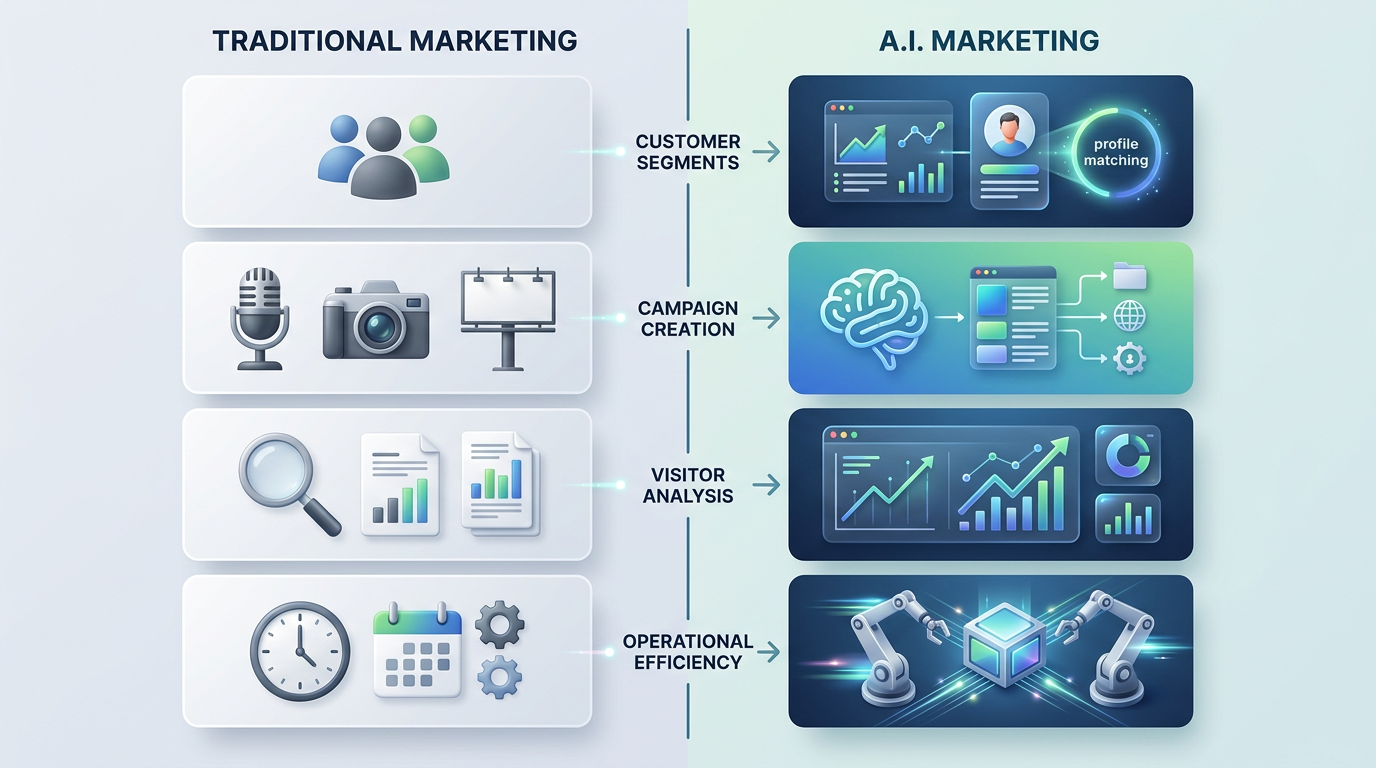
How AI Marketing Transforms Core Marketing Functions
AI impacts nearly every marketing discipline, but the transformation looks different depending on the function. Understanding these specific applications helps you prioritize where to invest first.
Content Creation and Optimization
AI tools can now generate blog posts, social media captions, ad copy, product descriptions, and email sequences at scale. Tools like ChatGPT, Claude, and Jasper use large language models trained on billions of text examples to produce content that sounds natural and follows your brand guidelines.
The quality varies significantly based on how you use these tools. Generic prompts produce generic content. Detailed prompts with context about your audience, product differentiation, and desired outcomes produce content that actually converts. The best approach treats AI as a collaborative writing partner, not a replacement for strategic thinking.
Beyond creation, AI optimizes existing content by analyzing performance data to recommend improvements. AI-powered SEO tools identify keyword gaps, suggest semantic variations, and predict which topics will drive the most organic traffic based on search trends and competitive analysis.
Audience Segmentation and Personalization
Traditional segmentation divides customers into broad categories like demographics or purchase history. AI segmentation identifies micro-segments based on hundreds of behavioral signals, purchase patterns, content engagement, browsing behavior, and predicted lifetime value.
These granular segments enable personalization that actually feels personal. Instead of sending the same email to everyone in a segment, AI systems can generate unique subject lines, personalize product recommendations, adjust messaging tone, and modify offers based on individual customer data.
According to research from McKinsey, companies that excel at personalization generate 40% more revenue from those activities than average players. AI makes this level of personalization operationally feasible without requiring massive creative teams.
Advertising and Campaign Optimization
AI marketing transforms paid advertising through automated bidding, dynamic creative optimization, and predictive audience targeting. Platforms like Google Ads and Meta Ads use machine learning to automatically adjust bids based on conversion likelihood, test thousands of ad variations simultaneously, and identify lookalike audiences with higher precision than manual targeting.
The shift from manual campaign management to AI-driven optimization can feel uncomfortable at first. You’re trusting algorithms with budget decisions. But the data consistently shows that machine learning systems outperform manual optimization once they have sufficient conversion data to learn from. The key is providing clear conversion goals and enough budget for the algorithm to test effectively during the learning phase.
Essential AI Marketing Tools Worth Your Investment
The AI marketing tool landscape changes rapidly, but certain categories consistently deliver measurable ROI. Focus on tools that solve specific problems rather than chasing features you might use someday.
| Tool Category | Primary Use Case | Expected ROI Timeline |
|---|---|---|
| AI Content Platforms | Blog writing, ad copy, social content generation | Immediate time savings |
| Predictive Analytics | Customer churn prediction, lifetime value forecasting | 3-6 months |
| AI Agents | Automated workflows, multi-step task execution | 1-3 months |
| Chatbots and Conversational AI | Customer support, lead qualification, booking | 1-2 months |
| AI SEO Tools | Keyword research, content optimization, SERP analysis | 3-6 months |
| Marketing Automation with AI | Email personalization, journey optimization, scoring | 2-4 months |
The ROI timeline matters because it affects how you budget and measure success. Content tools deliver immediate time savings but may not immediately improve conversion rates. Predictive analytics takes longer to show value because you need time to collect data, build models, and act on predictions before you can measure the outcome.
Choosing Tools That Actually Integrate
The biggest AI marketing mistake is buying individual point solutions that don’t talk to each other. Your AI content tool generates great copy, but it can’t access your CRM data to personalize messaging. Your predictive analytics platform identifies high-value customers, but you have to manually export that data to your email platform.
Prioritize tools that integrate with your existing marketing stack or choose platforms that combine multiple AI capabilities. HubSpot, for example, now includes AI content generation, predictive lead scoring, and conversational chatbots in a single platform that shares customer data across all functions.
If you need best-of-breed specialized tools, invest in integration platforms like Zapier or Make.com that can connect your AI tools to your CRM, email platform, analytics, and advertising accounts. The coordination between tools matters more than the individual capabilities of any single tool.
Building Your AI Marketing Strategy Step by Step
Starting with AI marketing feels overwhelming when you see the full range of possibilities. The practical approach is to start with high-impact, low-complexity use cases and expand as you build confidence and internal capabilities.
Step one: Identify your biggest marketing bottleneck. Is it content production? Lead qualification? Ad performance? Customer retention? Choose the problem that costs you the most time or money right now.
Step two: Research AI solutions specifically designed for that problem. Read case studies from businesses similar to yours. Test free trials. Talk to current users about implementation challenges and actual results.
Step three: Start with a focused pilot project. Don’t try to implement AI across your entire marketing operation at once. Pick one campaign, one channel, or one customer segment for your initial test.
Step four: Define clear success metrics before you start. How will you know if the AI solution is working? What baseline performance are you comparing against? What improvement would justify the investment?
Step five: Plan for the learning curve. AI tools require training data, configuration, and human oversight. Budget 30-90 days for setup and optimization before expecting full results.
Step six: Document what works and what doesn’t. AI marketing success comes from continuous improvement. Keep notes on which prompts generate the best content, which audience segments respond to AI-personalized messaging, and which campaigns benefit most from automated optimization.
Common AI Marketing Mistakes That Waste Budget
The hype around AI marketing leads many businesses to invest in the wrong tools, implement them poorly, or expect unrealistic results. Avoiding these common mistakes saves time and money.
Buying AI tools without clear use cases. Features that sound impressive in a demo often sit unused because they don’t solve an actual problem in your workflow. Always start with the problem, then find the AI solution, not the other way around.
Expecting AI to replace strategy. AI executes tactics brilliantly, but it can’t define your positioning, identify your ideal customer, or determine your value proposition. Strategic thinking remains human work. AI amplifies good strategy and automates poor strategy equally well.
Ignoring data quality. AI marketing tools learn from your existing data. If your CRM is full of duplicates, your email list hasn’t been cleaned in years, and your analytics tracking is broken, AI will learn from garbage and produce garbage. Clean data infrastructure must come first.
Not providing enough training data. Machine learning algorithms need sufficient examples to identify patterns. Predictive models need hundreds or thousands of conversions to make accurate predictions. Automated bidding needs conversion volume to optimize effectively. Implementing AI before you have adequate data volume leads to poor performance and false conclusions about whether the tool works.
Failing to monitor AI outputs. AI-generated content can include factual errors, brand voice inconsistencies, or inappropriate messaging. Chatbots can misunderstand customer questions. Automated campaigns can optimize toward the wrong goal. Human oversight remains essential, especially in the early stages of implementation.
Measuring the Real ROI of AI Marketing
AI marketing investments should improve specific business metrics, not just make your marketing team’s work easier. The metrics that matter depend on which AI applications you implement.
For AI content tools, measure time saved per piece of content, cost per content unit, organic traffic growth, and conversion rate changes. A tool that cuts content production time in half but reduces conversion rates by 20% is not delivering positive ROI.
For predictive analytics and AI agents, measure the accuracy of predictions, the revenue impact of acting on those predictions, and the time saved on manual analysis. If your churn prediction model is 75% accurate and you retain 30% of the customers it flags for intervention, calculate the revenue value of those retained customers minus the cost of the intervention program and the AI tool.
For advertising AI, measure cost per acquisition, return on ad spend, and the delta between AI-optimized campaigns and manual campaigns. Run controlled tests where possible, with one campaign using AI optimization and an identical campaign using your previous manual approach.
The key is isolating the AI impact from other variables. Marketing results fluctuate due to seasonality, competitive actions, product changes, and broader economic conditions. Use controlled comparisons, adequate test durations, and statistical significance testing before concluding that AI is or isn’t working.
The Future of AI Marketing and What to Prepare For
AI marketing capabilities are evolving rapidly. Understanding the likely trajectory helps you invest in tools and skills that will remain relevant as the technology advances.
Generative AI will continue improving in quality and expanding into more media types. Text generation is already highly capable. Image generation is improving rapidly. Video generation is emerging. Audio and voice synthesis are becoming indistinguishable from human speakers. This means content production costs will continue falling while personalization scale continues rising.
AI agents will handle increasingly complex multi-step marketing workflows. Instead of just generating an email, an AI agent might research your competitor’s new product launch, draft a competitive response campaign, generate ad variations, set up targeting parameters, and monitor performance automatically. According to Gartner, agentic AI systems that can independently complete complex tasks will become mainstream marketing tools within the next few years.
Privacy regulations and data restrictions will shape how AI marketing tools access and use customer information. Platforms are already moving toward privacy-preserving AI that can personalize without exposing individual user data. Marketers who build first-party data assets and consent-based customer relationships will have significant advantages as third-party data becomes less accessible.
The competitive advantage from simply using AI marketing tools will diminish as adoption becomes universal. The advantage will shift to how well you use AI, how effectively you combine AI with human creativity and strategic thinking, and how quickly you adapt to new capabilities. Continuous learning and experimentation will matter more than any single tool or tactic.
Frequently Asked Questions About AI Marketing
What is AI marketing and how does it differ from traditional marketing automation?
AI marketing uses machine learning, natural language processing, and predictive analytics to make intelligent decisions and automate complex tasks that previously required human judgment. Traditional marketing automation follows predetermined rules and workflows you set up manually. AI marketing adapts its behavior based on data, learns from outcomes, and can handle ambiguous situations without explicit programming. For example, traditional automation sends an email when someone downloads a whitepaper. AI marketing analyzes that person’s entire behavioral history, predicts their likelihood to buy, generates personalized content variations, determines the optimal send time, and adjusts the follow-up sequence based on engagement patterns.
How much does implementing AI marketing cost for a small to medium business?
AI marketing costs vary dramatically based on which tools you implement and whether you build custom solutions or use off-the-shelf platforms. Basic AI content tools start around $20-100 per month for individual subscriptions. Comprehensive marketing platforms with built-in AI capabilities like HubSpot or Salesforce range from $800-5,000+ per month depending on features and contact volume. Enterprise predictive analytics platforms can cost $50,000+ annually. For most small to medium businesses, a practical starting budget is $500-2,000 per month for a combination of AI content tools, chatbot platforms, and AI-enhanced email marketing. The ROI typically justifies higher investment as you prove value with initial implementations.
Can AI marketing tools replace human marketers?
AI marketing tools automate tactical execution and data analysis but cannot replace strategic thinking, creative direction, brand development, or relationship building that human marketers provide. The most effective approach treats AI as a force multiplier for human marketers rather than a replacement. AI handles repetitive tasks like content drafting, data analysis, campaign optimization, and personalization at scale. This frees human marketers to focus on strategy, creative concepts, customer insights, partnership development, and complex problem-solving that AI cannot handle. Companies that combine AI automation with skilled human marketers consistently outperform those that try to replace humans entirely or those that avoid AI altogether.
How long does it take to see results from AI marketing implementation?
Results timelines depend on which AI marketing applications you implement and how mature your existing marketing operations are. AI content tools can deliver immediate time savings, with measurable productivity improvements in the first week. Chatbots and conversational AI typically show impact within 4-8 weeks once properly trained and integrated. Predictive analytics and AI-driven personalization usually require 3-6 months to collect sufficient data, build accurate models, and optimize based on results. AI advertising optimization often shows improvement within 2-4 weeks but continues improving over 2-3 months as the algorithm learns. The key factor is having sufficient data volume for AI systems to learn from, which is why businesses with larger customer bases and higher transaction volumes often see faster results.
What are the biggest risks of using AI in marketing?
The primary risks include generating inaccurate or inappropriate content that damages your brand, over-relying on AI recommendations without human judgment, privacy violations from mishandling customer data, and competitive disadvantage if AI tools optimize toward the wrong business objectives. AI-generated content can include factual errors, biased language, or messaging that doesn’t align with your brand values, which is why human review remains essential. AI optimization algorithms can maximize short-term metrics like click-through rates while harming long-term brand perception or customer relationships. Data privacy risks emerge when AI tools process customer information without proper consent or security measures. Mitigating these risks requires clear AI governance policies, human oversight of AI outputs, careful vendor selection, and ongoing monitoring of AI system performance against business goals rather than just algorithmic metrics.
How do I choose the right AI marketing tools for my business?
Start by identifying your biggest marketing constraint, whether that’s content production capacity, lead quality, personalization scale, or campaign optimization. Research AI tools specifically designed to address that constraint and evaluate them based on integration with your existing marketing stack, ease of implementation, vendor stability and support quality, transparent pricing, and case studies from similar businesses. Test multiple options through free trials with real use cases from your business rather than generic demo scenarios. Measure results against your current baseline performance using clear metrics. Prioritize tools that solve immediate problems and can scale with your needs rather than purchasing based on features you might use eventually. Consider working with an AI marketing agency like TAMA to accelerate tool selection and implementation if you lack internal AI expertise.

Taking the Next Step With AI Marketing
AI marketing is not a future trend to monitor. It’s a present reality that’s already reshaping how effective marketing teams operate. The businesses seeing the greatest impact are those that move past experimentation into systematic implementation across their core marketing functions.
The key is starting strategically rather than trying to adopt every AI tool at once. Identify where AI can solve your most expensive marketing problems, choose proven tools that integrate with your existing systems, and measure results rigorously so you know what’s actually working.
If you’re ready to implement AI marketing but want expert guidance on which tools and strategies will deliver the best ROI for your specific business, TAMA offers a free AI growth analysis. We’ll analyze your current marketing operations, identify high-impact AI opportunities, and provide a custom implementation roadmap. No generic advice, just specific recommendations based on your business model, customer data, and growth objectives.