AI Agency: How to Scale Revenue with AI-Powered Marketing Teams

Most marketing agencies are still selling manual strategy execution while their competitors are building AI-powered marketing engines that deliver faster results at lower costs. If you’re evaluating an AI agency or wondering whether AI-driven marketing is worth the investment, you’re asking the right question. The difference between a traditional marketing partner and an AI agency isn’t just the tools they use, it’s how they structure campaigns, automate decision-making, and scale performance without ballooning your budget.
An AI agency uses machine learning, automation platforms, and intelligent workflows to handle the repetitive, data-heavy tasks that traditionally require hours of manual work. That includes content production, audience segmentation, bid optimization, lead scoring, email sequencing, and performance analysis. The result is faster execution, better targeting, and marketing systems that improve themselves over time.
This article breaks down what an AI agency actually does, how it differs from traditional marketing firms, when it makes sense to hire one, and what you should look for during the selection process.
What Defines an AI Agency
An AI agency is a marketing partner that integrates artificial intelligence into the core of its service delivery. That means AI isn’t just a feature or a tool they occasionally use, it’s embedded in how they plan, execute, and optimize campaigns.
Traditional agencies rely on human teams to run Google Ads, write content, segment email lists, analyze performance, and adjust strategy. AI agencies use automation platforms and intelligent systems to handle those tasks at scale, freeing their strategists to focus on high-level decisions, creative direction, and business outcomes.
Here’s what that looks like in practice:
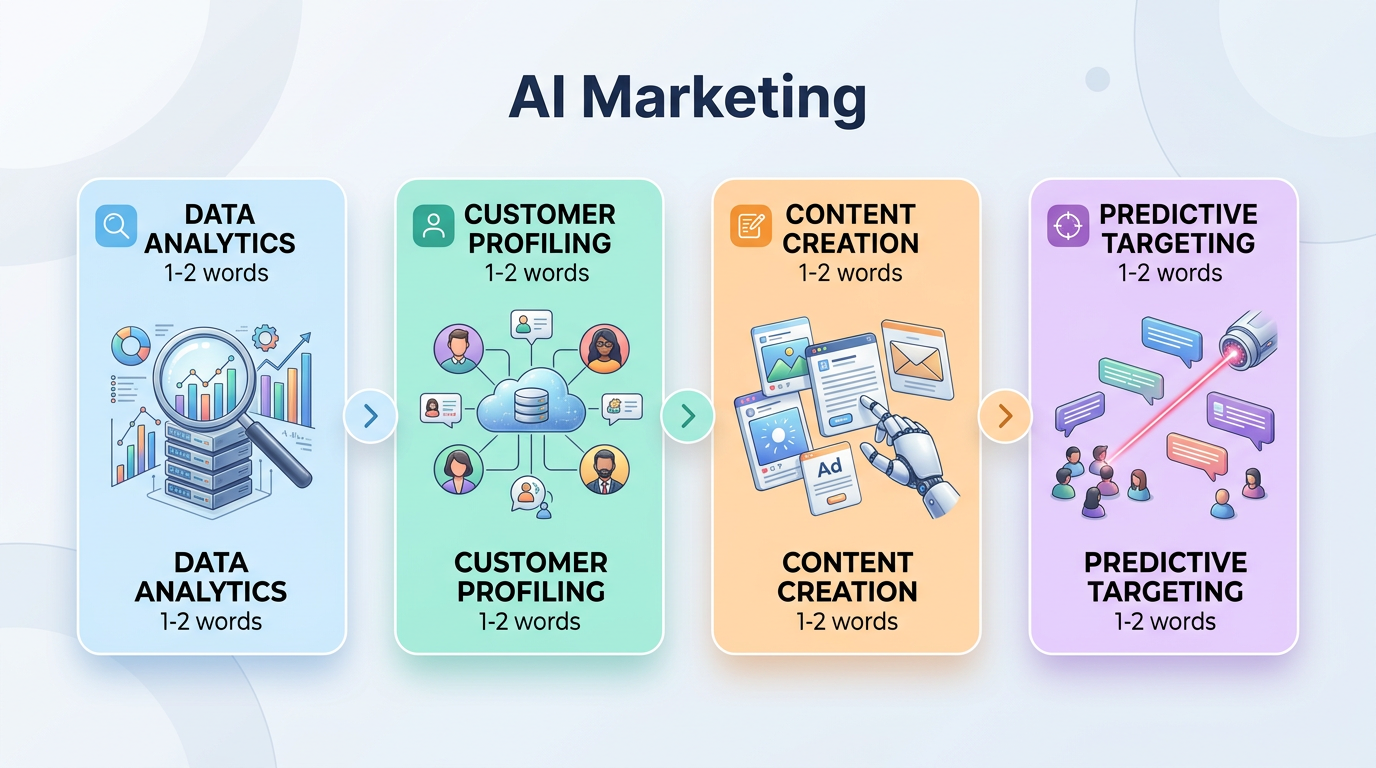
- Content creation powered by language models that generate blog posts, ad copy, and email sequences based on performance data and brand voice guidelines
- Audience segmentation driven by machine learning models that analyze behavior patterns and predict which prospects are most likely to convert
- Bid management and budget allocation handled by algorithms that optimize in real time across dozens of campaigns and ad groups
- Lead scoring systems that rank prospects based on engagement signals, purchase intent, and historical conversion data
- Performance dashboards that surface insights automatically and recommend next actions without requiring manual data pulls
The shift from manual execution to AI-powered workflows allows these agencies to deliver faster results, handle more clients without sacrificing quality, and reduce the cost per outcome. For businesses, that translates into lower customer acquisition costs, shorter campaign launch timelines, and better return on ad spend.
How AI Agencies Differ from Traditional Marketing Firms
The core difference between an AI agency and a traditional marketing firm is execution capacity. Traditional agencies are constrained by human hours. Every campaign, every landing page, every email sequence requires someone to build it, test it, and monitor it manually.
AI agencies remove that bottleneck by automating the production and optimization layers. That doesn’t mean they replace strategists or creative teams, it means those teams focus on strategy, messaging, positioning, and creative direction while automation handles the execution.
Speed and Scale
Traditional agencies take weeks to launch a campaign because every step requires manual input. An AI agency can deploy campaigns in days by using templates, automated asset generation, and pre-built workflows that adapt to your business model.
If you need to test 50 ad variations across 10 audience segments, a traditional agency will struggle to keep up. An AI agency can launch, monitor, and optimize all 500 combinations simultaneously.
Data-Driven Decision Making
Traditional agencies rely on periodic reports and human interpretation of performance data. AI agencies use real-time dashboards, predictive analytics, and machine learning models that surface insights automatically and recommend adjustments before performance drops.
That means you’re not waiting for a monthly review to find out your cost per lead doubled. The system flags the issue, identifies the cause, and suggests a fix within hours.
When You Should Hire an AI Agency
Not every business needs an AI agency. If you’re running a small local service business with a limited marketing budget and simple campaign needs, a traditional agency or freelancer might be a better fit.
AI agencies deliver the most value when you’re dealing with complexity, scale, or speed constraints that manual execution can’t handle efficiently.
Here are the clearest signals that an AI agency makes sense:
- You’re running multi-channel campaigns across search, social, display, email, and retargeting, and you need consistent messaging and coordinated optimization across all of them
- You’re testing dozens of audience segments, ad variations, and landing pages, and you need a system that can manage and optimize all of them without requiring a massive team
- You’re scaling fast and your current agency or internal team can’t keep up with content production, campaign launches, or performance analysis
- You’re spending significant money on ads but your attribution is unclear, your reporting is slow, and your optimization decisions are based on gut feel rather than data
- You want to implement advanced marketing automation like lead scoring, dynamic email sequences, or behavior-triggered campaigns, but your current team doesn’t have the technical expertise
If any of those scenarios describe your business, an AI agency can reduce costs, improve performance, and free up your team to focus on strategy rather than execution.
Core Services AI Agencies Provide
AI agencies typically offer the same service categories as traditional marketing firms, content, ads, email, SEO, automation, but they deliver them using intelligent systems that reduce manual effort and improve outcomes.
AI-Powered Content Production
Content remains one of the most time-intensive parts of marketing. AI agencies use language models to generate blog posts, product descriptions, ad copy, email sequences, and social media content based on brand guidelines, performance data, and audience intent.
That doesn’t mean every piece of content is fully automated. Strategists define the messaging framework, the AI generates drafts, and editors refine the output. The result is higher volume without sacrificing quality.
Automated Campaign Management
AI agencies use platforms that handle bid adjustments, budget allocation, audience targeting, and ad placement automatically. Instead of manually adjusting bids every few days, the system optimizes in real time based on performance data and predefined goals.
That includes AI-powered Google Ads management, Facebook Ads automation, programmatic display buying, and cross-channel budget optimization.
Lead Scoring and Nurturing
AI agencies build systems that score leads based on behavior, engagement, and fit, then route them into automated nurturing sequences that adapt based on how prospects interact with your content.
That means your sales team focuses on high-intent prospects while the system continues to educate and engage everyone else until they’re ready to buy.
SEO and Content Strategy
AI agencies use machine learning tools to identify keyword opportunities, analyze competitor content, optimize on-page SEO, and monitor rankings across thousands of keywords. They also build AI-driven SEO strategies that adapt to algorithm changes and search intent shifts without requiring constant manual updates.
Performance Analytics and Reporting
Instead of static monthly reports, AI agencies provide real-time dashboards that track key metrics, surface anomalies, and recommend next actions. That includes attribution modeling, funnel analysis, cohort tracking, and predictive forecasting.
How to Choose the Right AI Agency for Your Business
Not all AI agencies are created equal. Some are traditional agencies that rebranded after adding a few automation tools. Others are tech-first firms that understand AI but lack marketing expertise. The best AI agencies combine deep marketing knowledge with genuine technical capability.
Here’s what to look for during the evaluation process:
Proven Results with Real Case Studies
Ask for case studies that show measurable outcomes. Look for specifics like cost per acquisition, conversion rate improvements, revenue growth, or time savings. Avoid agencies that only talk about technology without showing business results.
Technical Transparency
A good AI agency should be able to explain which tools and platforms they use, how their automation workflows are built, and how they measure performance. If they’re vague about their systems or refuse to share technical details, that’s a red flag.
Strategic Depth
AI automates execution, but strategy still requires human judgment. Make sure the agency has experienced strategists who understand your industry, target audience, and business model. Technology alone won’t fix bad strategy.
Integration Capability
Your AI agency needs to integrate with your existing tech stack. That includes your CRM, email platform, ad accounts, analytics tools, and any other systems you use. Ask about their integration process and whether they have experience with your specific tools.
Pricing Structure
AI agencies typically charge either a flat monthly retainer, a percentage of ad spend, or a hybrid model that combines both. Make sure you understand what’s included, what costs extra, and how pricing scales as your campaigns grow.
| Agency Type | Best For | Typical Cost | Key Advantage |
|---|---|---|---|
| Traditional Marketing Agency | Simple campaigns, local businesses, low volume | $2,000 to $10,000/month | Human touch, relationship-driven |
| AI Agency | Multi-channel campaigns, high volume, scale | $3,000 to $15,000/month | Speed, automation, data-driven optimization |
| In-House Team | Large budgets, full control, custom needs | $15,000+/month in salaries | Direct access, alignment with internal goals |
| Freelancer | One-off projects, tactical execution | $500 to $5,000/project | Low cost, flexibility |
The right choice depends on your budget, complexity, and growth goals. If you’re scaling fast and need consistent execution across multiple channels, an AI agency delivers better ROI than cobbling together freelancers or overloading an internal team.
Common Mistakes When Hiring an AI Agency
Many businesses make avoidable mistakes when selecting an AI agency. These errors typically stem from unrealistic expectations, poor vetting, or misaligned goals.
Here are the most common ones:
- Expecting AI to replace strategy: AI handles execution and optimization, but it doesn’t replace the need for clear positioning, messaging, and campaign strategy. If your agency can’t articulate a strategic vision, the technology won’t save you.
- Choosing based on price alone: The cheapest agency is rarely the best value. Low-cost AI agencies often use generic templates and minimal customization. You’ll pay less upfront but see weaker results.
- Ignoring technical fit: If the agency’s platforms don’t integrate with your existing systems, you’ll waste time on manual data transfers and lose the efficiency gains AI is supposed to deliver.
- Skipping the discovery process: A good AI agency should ask detailed questions about your business, audience, goals, and current performance before proposing a solution. If they pitch a one-size-fits-all package without understanding your needs, walk away.
- Failing to define success metrics: AI agencies optimize toward specific goals. If you don’t define what success looks like upfront, you’ll end up with campaigns that hit arbitrary metrics but don’t drive revenue.
Take the time to vet thoroughly, ask hard questions, and make sure there’s genuine alignment between what you need and what the agency delivers.
The Future of AI-Powered Marketing Partnerships
AI agencies are still evolving. The next wave of innovation will bring more sophisticated automation, better predictive modeling, and tighter integration between marketing, sales, and product data.
We’re already seeing agencies build agentic workflows that allow AI systems to make complex decisions autonomously, like adjusting budgets based on pipeline data, pausing underperforming campaigns, or launching new tests without human approval.
That doesn’t mean agencies will become fully autonomous. Human oversight, creative direction, and strategic judgment will remain critical. But the balance will continue to shift, with AI handling more execution and humans focusing on higher-order decision-making.
For businesses, that means working with an AI agency will become less about buying services and more about partnering with a system that learns, adapts, and improves over time. The agencies that thrive will be the ones that combine technical capability with genuine marketing expertise and a relentless focus on business outcomes.
Frequently Asked Questions About AI Agency Services
What is the main difference between an AI agency and a traditional marketing agency?
An AI agency uses automation platforms and machine learning to handle repetitive tasks like content creation, bid management, audience segmentation, and performance analysis. Traditional agencies rely on manual execution for most tasks. The result is that AI agencies can deliver faster results, handle more complexity, and scale campaigns without proportionally increasing costs. Traditional agencies are more relationship-driven and hands-on, which works well for simple campaigns but struggles with high-volume or multi-channel strategies.
How much does it cost to hire an AI agency?
AI agencies typically charge between $3,000 and $15,000 per month depending on campaign complexity, channel mix, and the level of customization required. Some agencies charge a flat retainer, others take a percentage of ad spend, and some use hybrid models. Pricing depends on the scope of work, the number of channels, the volume of content or ads, and the technical integrations needed. Always clarify what’s included in the base fee and what costs extra before signing a contract.
Can an AI agency replace my internal marketing team?
An AI agency can replace manual execution tasks but not strategic oversight, brand direction, or internal coordination. If your internal team is overloaded with campaign management, content production, and performance analysis, an AI agency can take those tasks off their plate and let them focus on strategy. However, you still need someone internally to define goals, approve creative, and ensure the agency’s work aligns with your business objectives. Think of an AI agency as an extension of your team, not a replacement.
What industries benefit most from working with an AI agency?
E-commerce, SaaS, B2B services, education, finance, and healthcare companies benefit most because they typically run multi-channel campaigns, have complex customer journeys, and need to manage large volumes of data. Any business that relies on digital marketing for lead generation or customer acquisition and has enough budget to justify automation will see strong ROI from an AI agency. Local service businesses with simple campaigns and small budgets may not see enough value to justify the cost.
How long does it take to see results from an AI agency?
Most AI agencies deliver early results within 30 to 60 days, but meaningful performance improvements typically take 90 to 120 days. The first month is usually spent on setup, integration, and baseline testing. The second and third months involve optimization and scaling. By month four, you should see measurable improvements in cost per acquisition, conversion rates, or revenue. If an agency promises instant results, be skeptical. Real performance gains come from continuous testing and optimization, not overnight magic.
What should I ask an AI agency before hiring them?
Ask them to explain their technology stack, show case studies with measurable outcomes, describe their integration process with your existing tools, clarify their pricing structure, and outline how they measure success. Also ask who will own your data and campaign assets, how often they report on performance, and what happens if you decide to end the partnership. A good agency will answer these questions clearly and confidently. If they dodge technical questions or refuse to share details, that’s a warning sign.

Making the Right Choice for Your Business
Hiring an AI agency is a strategic decision that affects how fast you can scale, how efficiently you spend your marketing budget, and how much time your internal team spends on repetitive tasks versus high-value strategy. The right agency acts as a force multiplier, delivering better results without requiring you to build an internal AI team from scratch.
The key is finding a partner that combines technical capability with marketing expertise, understands your business model, and focuses on outcomes rather than vanity metrics. Take the time to vet thoroughly, ask hard questions, and make sure there’s genuine alignment between what you need and what they deliver.
If you’re ready to explore how AI-powered marketing can scale your business, request a free growth plan from TAMA to see what’s possible.