Agentic Flows: AI Agents in Marketing

Marketing teams waste hours every week on repetitive tasks like qualifying leads, sending follow-up emails, updating CRM records, and pulling performance reports. These aren’t high-value activities, but they’re necessary for keeping campaigns running. Traditional marketing automation helps, but it still requires constant human oversight, manual triggers, and rigid if-then logic that breaks the moment a scenario changes.
Agentic flows represent a fundamentally different approach. Instead of following fixed automation rules, agentic flows use AI agents that can perceive context, make decisions, adapt to new information, and execute multi-step marketing tasks with minimal human intervention. Think of them as autonomous marketing team members that handle entire workflows, not just single actions.
This shift matters because it frees marketers to focus on strategy, creative work, and relationship building while AI agents handle the operational execution at scale.
What Are Agentic Flows in Marketing?
Agentic flows are AI-powered workflows where intelligent agents autonomously handle end-to-end marketing processes. Unlike traditional automation that requires you to map every decision point in advance, agentic flows give AI agents goals and guardrails, then let them determine the best path forward based on real-time data and context.
An agent in this context is a specialized AI system designed to complete specific tasks. It can access tools, retrieve information, analyze data, make decisions within defined parameters, and take action across multiple platforms without waiting for human approval at every step.
For example, a lead qualification agent might monitor new form submissions, research the company using public data sources, score the lead based on your ideal customer profile, update your CRM, and route qualified leads to the right sales rep with a personalized brief, all within minutes of the initial inquiry.
How Agentic Flows Differ from Traditional Marketing Automation
Traditional marketing automation platforms like HubSpot, Marketo, or ActiveCampaign use predefined workflows. You map out every scenario in advance: if someone downloads this asset, wait two days, then send this email. If they open it, add this tag. If they don’t, wait three more days and try again.
This approach works for simple, predictable sequences, but it becomes brittle when scenarios multiply. Every edge case requires another branch in your workflow diagram. You end up with spaghetti logic that’s hard to maintain and impossible to adapt quickly.
Agentic flows flip this model. Instead of programming every decision, you define the objective, provide the agent with access to necessary tools and data, and set boundaries around what it can and cannot do. The agent then determines the best sequence of actions to achieve the goal, adjusting in real time as conditions change.
Core Components of an Agentic Flow System
A functional agentic flow system for marketing includes several key elements working together. First, you need specialized AI agents trained for specific marketing tasks like content generation, lead research, email personalization, or performance analysis. Each agent has a defined role and scope.
Second, you need a tool layer that gives agents the ability to take action. This includes API connections to your CRM, email platform, analytics tools, ad accounts, content management system, and any other marketing technology in your stack.
Third, you need a reasoning and decision engine, typically powered by large language models, that allows agents to interpret instructions, assess context, plan multi-step processes, and adapt based on outcomes.
Fourth, you need safety guardrails and approval gates for high-stakes actions. Agentic flows should operate autonomously for routine tasks but flag unusual scenarios or high-value decisions for human review.
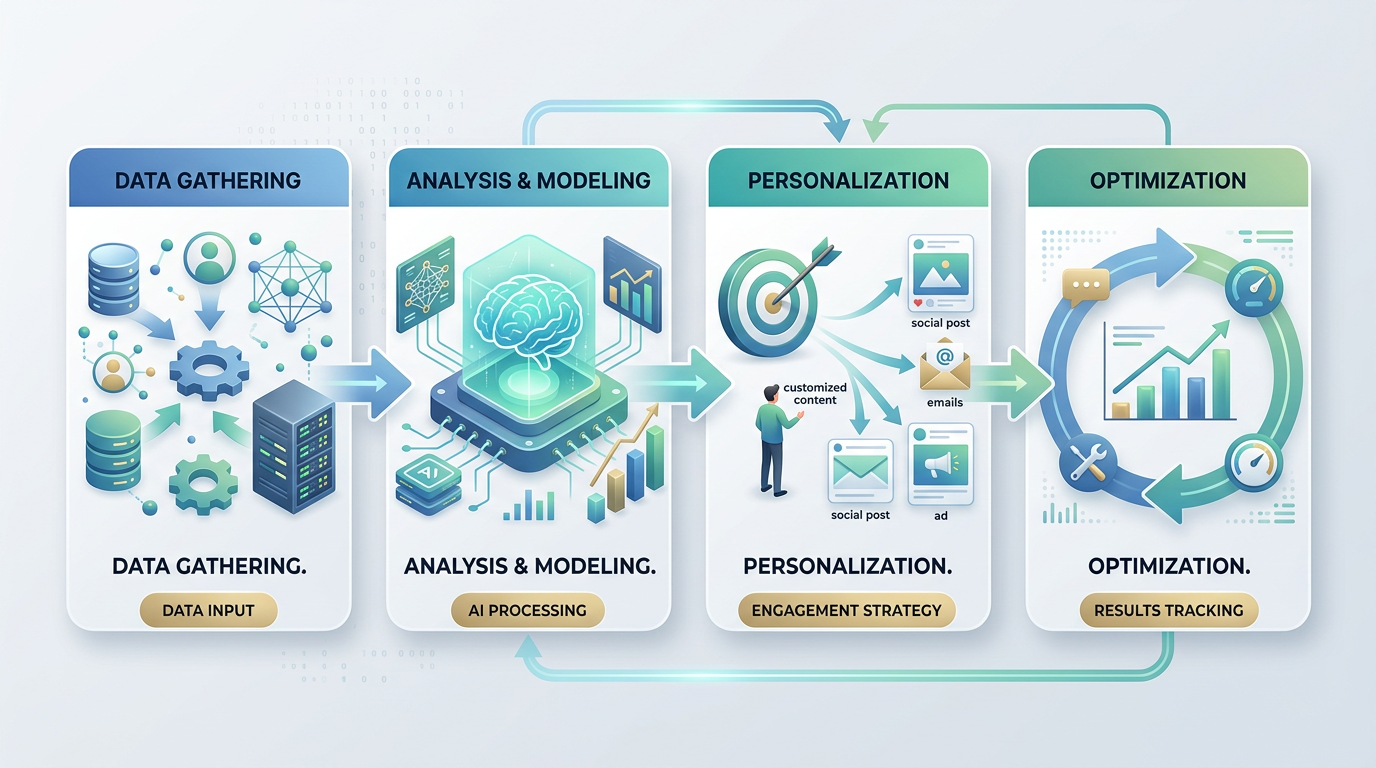
Finally, you need monitoring and feedback loops so agents learn from outcomes and improve over time. This includes tracking success metrics, identifying failure points, and refining agent instructions based on performance data.
Real-World Use Cases for Agentic Flows in Marketing
Understanding agentic flows in theory is one thing. Seeing how they solve actual marketing problems makes the concept concrete. Here are several practical scenarios where agentic flows deliver measurable value today.
Autonomous Lead Qualification and Routing
When a new lead enters your system through a website form, webinar registration, or content download, an agentic flow can automatically research the company, evaluate fit based on your ideal customer criteria, enrich the contact record with relevant data, personalize the first touchpoint, and route the lead to the appropriate team member, all within minutes.
The agent might check LinkedIn to verify the contact’s role, visit the company website to understand their business model, cross-reference firmographic data against your target account list, and score the lead based on multiple signals. If the lead is high-value, it could trigger an immediate Slack notification to sales with a briefing summary. If it’s lower priority, it might enter a nurture sequence tailored to the company’s industry and maturity stage.
This level of intelligent triage used to require a dedicated operations person manually reviewing every lead. Agentic flows handle it automatically while maintaining quality and personalization.
Dynamic Content Creation and Distribution
Content marketing requires constant production and distribution across multiple channels. An agentic flow for content can monitor industry news sources, identify trending topics relevant to your audience, generate article outlines, draft initial content, optimize for search intent, create social media variations, and schedule distribution across platforms.
The agent might scan recent developments in your industry, cross-reference them with your content calendar to avoid duplication, generate a first draft based on your brand voice guidelines, incorporate relevant data and examples, suggest internal links to existing content, and create accompanying social posts optimized for each platform’s format and audience.
While human editors still review and refine the output, the agent handles the initial research, drafting, and formatting work, compressing what used to take days into hours. This lets your team focus on strategic direction and high-value creative work rather than production logistics.
Automated Campaign Monitoring and Optimization
Managing multiple ad campaigns across Google, Facebook, LinkedIn, and other platforms requires constant monitoring and adjustment. An agentic flow for campaign management can track performance in real time, identify underperforming ads or audience segments, test variations, reallocate budget toward winning combinations, and flag anomalies for human review.
The agent might notice that a specific ad creative is driving 40% lower conversion rates than others in the same campaign, automatically pause it, and shift that budget to better-performing variants. It could detect that conversion costs are spiking on a particular audience segment, investigate whether it’s a temporary anomaly or a trend, and adjust targeting accordingly.
This kind of active management used to require a paid media specialist watching dashboards all day. Agentic flows make it continuous and automatic while surfacing strategic decisions to human marketers when input is needed.
Building Agentic Flows: Technical Requirements and Tools
Implementing agentic flows in your marketing stack requires a combination of the right AI models, integration tools, and workflow orchestration platforms. You don’t necessarily need to build everything from scratch, but you do need to understand the technical layer enough to make informed decisions.
Most agentic systems today are built on large language models like GPT-4, Claude, or Gemini, which provide the reasoning and natural language capabilities that allow agents to interpret instructions, analyze context, and generate appropriate responses. These models serve as the brain of the agent.
To connect agents to your marketing tools, you’ll use API integrations, either through direct API calls or through integration platforms like Zapier, Make.com, or n8n. The goal is to give agents read and write access to the systems where marketing work happens: your CRM, email platform, analytics tools, content management system, and ad accounts.
Workflow orchestration platforms like LangChain, CrewAI, or AutoGen help you define agent roles, chain together multi-step processes, manage tool access, and handle error conditions. These frameworks provide the structure that turns a language model into a functional agent system.
For marketing teams without deep technical resources, emerging no-code and low-code platforms are starting to offer pre-built agentic templates for common marketing workflows. These tools abstract away much of the complexity while still giving you control over agent behavior and integration points.
Security and data governance matter significantly in agentic systems. Agents need access to customer data and the ability to take action on behalf of your brand, so you must implement proper authentication, permission scoping, activity logging, and approval workflows for sensitive operations.
Common Mistakes When Implementing Agentic Flows
As powerful as agentic flows can be, they’re easy to implement poorly. Most early failures come from a handful of predictable mistakes that stem from misunderstanding how agent systems work or expecting too much too soon.
One common error is giving agents goals that are too vague or too broad. An instruction like “improve our marketing performance” gives an agent no clear success criteria, no boundaries, and no actionable starting point. Effective agentic flows require specific, measurable objectives with clear constraints. Instead of “improve performance,” try “monitor our email campaigns daily and flag any campaign with open rates 20% below our baseline for review.”
Another mistake is failing to implement proper guardrails and approval gates. Letting an agent autonomously send emails to your entire list or adjust ad budgets without limits invites disaster. Start with read-only access and human-in-the-loop approval for any action that could damage your brand or waste significant budget. Gradually expand autonomy as you build confidence in the system.
Many teams also underestimate the importance of agent instructions and context. Agents perform best when they have clear role definitions, access to relevant historical data and brand guidelines, and explicit examples of good and bad decisions. The quality of your agent’s output directly correlates with the quality of the context and instructions you provide.
Over-automation is another pitfall. Not every marketing task benefits from an agentic approach. High-stakes creative decisions, strategic positioning work, and relationship-building activities still require human judgment and emotional intelligence. Use agentic flows for repetitive, data-driven, multi-step operational tasks, not for activities that fundamentally require human creativity and intuition.
Finally, many implementations fail because teams don’t establish proper monitoring and feedback mechanisms. Agents will make mistakes, especially early on. You need systems to catch errors quickly, understand why they happened, and adjust agent instructions or constraints accordingly. Without this feedback loop, problems compound instead of getting resolved.
Measuring the Impact of Agentic Flows on Marketing Performance
Implementing agentic flows requires investment in new tools, process changes, and training. To justify that investment and optimize your approach over time, you need clear metrics that show whether agentic automation is actually improving marketing outcomes.
Start by measuring time savings. Track how long specific workflows took before and after implementing agentic flows. For example, if lead qualification used to require 15 minutes of manual research and data entry per lead, and an agent now handles it in under two minutes, that’s a meaningful efficiency gain. Multiply that across hundreds of leads per month, and you can quantify the operational impact.
Quality metrics matter as much as speed. For lead qualification agents, track how often they correctly identify high-value prospects compared to your previous manual process. For content agents, measure whether AI-generated drafts require more or less editing than content from other sources. For campaign optimization agents, compare the performance of agent-managed campaigns to human-managed campaigns over equivalent time periods.
Consistency is another key metric. Agents don’t get tired, distracted, or inconsistent. If your agentic flow for customer follow-up ensures every lead gets contacted within 24 hours with a personalized message, measure your contact rate before and after implementation. Improved consistency often translates directly to better conversion rates.
Cost efficiency provides a financial lens on impact. Calculate the fully loaded cost of having a human perform a specific workflow, including salary, benefits, overhead, and opportunity cost. Compare that to the cost of running an agentic flow, including platform fees, API costs, and human oversight time. For most repetitive workflows, agentic flows deliver substantial cost savings once implemented properly.
Finally, track downstream business outcomes. Are qualified leads converting to opportunities at a higher rate? Is content engagement improving? Are campaign costs per acquisition decreasing? The goal of agentic flows isn’t just to automate tasks, it’s to improve marketing effectiveness. Connect automation metrics to business results to tell the complete story.
| Metric Category | Example Measurement | What It Tells You |
|---|---|---|
| Time Savings | Minutes saved per workflow execution | Operational efficiency and capacity gained |
| Quality | Accuracy rate, error rate, edit rate | Whether automation maintains or improves output quality |
| Consistency | Percentage of tasks completed on time and to standard | Reliability and process adherence |
| Cost Efficiency | Cost per task completed, human vs. agent | Financial return on automation investment |
| Business Outcomes | Conversion rates, engagement rates, revenue per lead | Impact on actual marketing and business results |
The most compelling case for agentic flows comes when you can show improvements across multiple metric categories simultaneously, demonstrating that automation isn’t just faster or cheaper, but actually more effective at achieving marketing goals.
How Agentic Flows Integrate with AI SEO and Content Strategy
Agentic flows aren’t isolated automation tools. They work best when integrated into broader marketing strategies, particularly in areas like AI SEO and content operations where data-driven, repetitive, and multi-step processes are common.
In SEO, agentic flows can automate technical audits, content gap analysis, and optimization recommendations. An SEO agent might crawl your site weekly, identify new technical issues, check for broken internal links, flag pages with thin content, and generate prioritized fix lists with specific recommendations. Another agent could monitor competitor content, identify topics where they’re ranking and you’re not, and suggest content opportunities based on search volume and relevance to your business.
For content production and distribution, agentic flows can handle the operational logistics that slow down content teams. Agents can manage editorial calendars, track content through production stages, ensure proper optimization before publishing, distribute finished content across channels, monitor performance, and surface insights about what’s working. This lets writers and strategists focus on the creative and strategic work while agents handle coordination and execution.
Keyword research and content optimization are natural fits for agentic workflows. An agent can identify target keywords, analyze top-ranking content for those terms, extract common patterns and topics, generate content briefs that match search intent, and provide real-time optimization feedback as writers work. This transforms SEO from a manual checklist into an integrated part of the content creation process.
Link building and outreach workflows also benefit from agentic automation. Agents can identify relevant link prospects, research contact information, personalize outreach emails based on the recipient’s content and interests, track responses, and manage follow-up sequences. While humans should still handle relationship building and negotiation, agents can manage the research and logistics that make outreach campaigns time-consuming.
The key advantage of combining agentic flows with SEO and content work is that these disciplines require both strategic thinking and operational execution. Agents excel at the operational layer, freeing human experts to focus on strategy, creativity, and relationship work that genuinely requires human judgment.
The Future of Marketing with Agentic Flows
Agentic flows are still early in their evolution, but the trajectory is clear. As AI models become more capable, as integration tools become more accessible, and as marketing teams gain experience working alongside AI agents, the scope and sophistication of marketing automation will expand significantly.
In the near term, expect to see agentic flows handling increasingly complex multi-step workflows that currently require coordination across multiple team members. An agent might manage an entire product launch sequence, coordinating content creation, email campaigns, social distribution, paid promotion, and performance tracking across a six-week timeline with minimal human intervention beyond strategic oversight and approval gates.
Personalization will become far more sophisticated as agents gain the ability to dynamically tailor every customer interaction based on comprehensive context. Instead of segmenting your audience into broad personas, agentic systems will treat each prospect as a segment of one, adjusting messaging, timing, content, and offers based on individual behavior, preferences, and context.
Cross-channel orchestration will improve as agents manage presence and consistency across every platform where your brand shows up. An agent might monitor brand mentions across social platforms, respond to comments and questions in your brand voice, identify opportunities for engagement, and escalate conversations that require human attention or present strategic opportunities.
Predictive capabilities will advance as agents analyze patterns across large datasets to anticipate customer needs, identify at-risk accounts, surface expansion opportunities, and recommend proactive interventions before problems occur. Marketing will shift from reactive response to proactive orchestration.
The most significant shift, however, will be cultural. Marketing teams will need to learn how to work effectively alongside AI agents, defining clear roles, setting appropriate boundaries, providing quality oversight, and continuously refining agent instructions based on outcomes. The most successful marketers won’t be those who resist automation, but those who learn to leverage it strategically while focusing their own efforts on the work that requires distinctly human capabilities.
Getting Started with Agentic Flows in Your Marketing Stack
If you’re ready to explore agentic flows for your marketing operations, start small and focused rather than attempting to automate everything at once. Identify one specific, repetitive, multi-step workflow that’s consuming significant team time and producing inconsistent results. This might be lead enrichment, content distribution, weekly reporting, or competitor monitoring.
Map out the current process in detail. Document every step a human currently takes, the tools they use, the decisions they make, and the criteria they use to make those decisions. This documentation becomes the foundation for designing your agentic flow.
Choose the right tools for your technical comfort level. If your team has engineering resources, platforms like LangChain or CrewAI offer maximum flexibility and control. If you prefer low-code options, look at integration platforms with emerging AI agent features. Some marketing automation platforms are beginning to incorporate agentic capabilities natively.
Build a minimum viable agent focused on the core workflow you identified. Start with read-only access and human approval for all actions. This lets you test the agent’s decision-making quality without risk. Run it in parallel with your existing process for several weeks, comparing outcomes and identifying where the agent performs well and where it struggles.
Gradually expand autonomy as you build confidence. First, let the agent execute low-risk actions automatically. Then, increase the scope of decisions it can make independently. Eventually, you’ll reach a point where human oversight is needed only for edge cases and strategic decisions.
Document agent instructions, tool access, and performance standards. As you refine the system, this documentation becomes your operating manual for scaling agentic flows to other workflows.
Finally, invest in training your team to work effectively with agents. This includes understanding what agents can and cannot do well, how to write clear instructions, how to interpret agent outputs, and when to intervene. The technical implementation matters, but organizational adoption determines whether agentic flows deliver lasting value.

Frequently Asked Questions About Agentic Flows
What is the difference between agentic flows and traditional marketing automation?
Traditional marketing automation follows fixed if-then rules that you program in advance, while agentic flows use AI agents that can perceive context, make decisions, and adapt their behavior based on real-time information. Agentic flows handle ambiguity and complexity better because the agent can reason about the best course of action rather than following a rigid script. Traditional automation works well for simple, predictable sequences, while agentic flows excel at multi-step workflows that require judgment and adaptation.
Do I need technical expertise to implement agentic flows?
The technical requirements vary depending on your approach. If you use emerging low-code platforms with pre-built marketing agents, you can implement basic agentic flows without deep technical skills. However, more sophisticated implementations that involve custom agent design, complex tool integration, and advanced reasoning capabilities typically require some combination of technical resources, whether in-house or through an agency partnership. Most marketing teams find success starting with simpler use cases using accessible tools, then expanding as they build experience and confidence.
What marketing tasks are best suited for agentic flows?
The best candidates for agentic flows are repetitive, multi-step workflows that require some decision-making but follow consistent logic. Examples include lead qualification and routing, content distribution and optimization, campaign monitoring and adjustment, weekly reporting and analysis, competitor tracking, and customer outreach sequences. Tasks that require genuine creativity, strategic positioning, or deep emotional intelligence remain better suited for human execution, at least with current technology.
How much do agentic flow systems cost to implement?
Costs vary widely based on your approach. Using API access to large language models directly might cost a few hundred dollars per month for moderate usage. Low-code platforms with agent capabilities typically charge subscription fees ranging from several hundred to several thousand dollars monthly depending on features and usage limits. Custom implementations with specialized tools and engineering resources can require significant upfront investment. For most marketing teams, the cost is far less than hiring additional staff to handle the same workflows manually, and the return comes primarily from time savings and improved consistency.
Are there risks involved in letting AI agents handle marketing tasks autonomously?
Yes, autonomous systems always carry some risk, which is why proper guardrails and oversight are essential. Agents can make errors, misinterpret instructions, or take actions based on incomplete context. The key is implementing appropriate safety measures like starting with read-only access, requiring human approval for high-stakes actions, setting clear boundaries on what agents can and cannot do, monitoring agent activity closely especially during early implementation, and having rollback procedures for when things go wrong. With proper design and oversight, the risks are manageable and far outweighed by the benefits for most marketing workflows.
How long does it take to see results from implementing agentic flows?
Timeline depends on the complexity of the workflow and your implementation approach. Simple workflows like automated reporting or content distribution can show time savings within days of implementation. More complex agents handling lead qualification or campaign optimization might require several weeks of parallel testing and refinement before you’re confident enough to rely on them fully. Most teams see meaningful efficiency gains within the first month for initial workflows, with impact growing as they expand to additional use cases and refine agent performance over time. The learning curve means early workflows take longer to implement than later ones as your team builds experience.