Vibe Coding Versus Regular Coding: The Future of AI Development
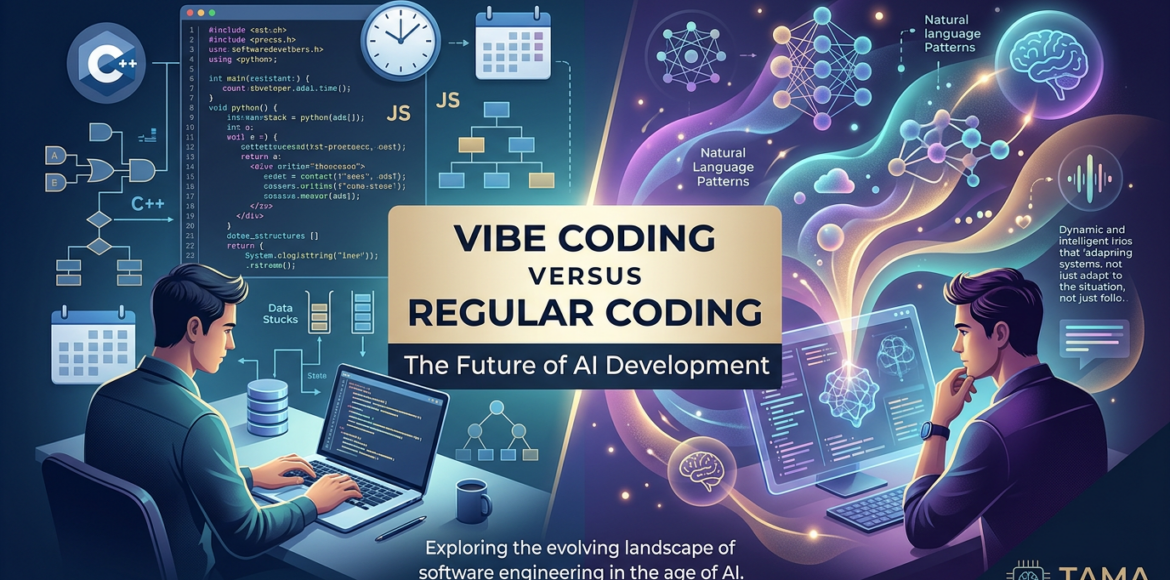
You are sitting in front of your terminal, staring at a syntax error that has consumed the last three hours of your afternoon. You know exactly what the logic should do, but the rigid requirements of the language are fighting you at every semicolon. This is the friction of traditional development—a world where the technical implementation often overshadows the creative intent. But a shift is happening in how we build software, moving away from manual syntax toward a flow-state driven approach known as Vibe coding versus regular coding.
At TAMA – The AI Marketing Agency, we see this shift as the ultimate unlock for business growth. It is no longer about how fast you can type code, but how clearly you can articulate a vision to an AI agent that handles the heavy lifting. This article explores the fundamental differences between these two worlds and how you can leverage them to build marketing tools, automations, and applications at ten times your current speed.
Understanding Vibe Coding Versus Regular Coding in 2025
Vibe coding is a term that has recently gained traction within the developer community to describe a high-level, intent-based way of building software. In this model, the developer acts more like a creative director or an architect. Instead of writing every line of Python or JavaScript, you provide high-level instructions, feedback, and “vibes” to an AI tool like Cursor, Replit Agent, or Claude Engineer. The AI interprets the goal, generates the code, and the human simply course-corrects until the result matches the vision.
Regular coding, by contrast, is the foundational practice of manual software engineering. It requires a deep understanding of syntax, memory management, design patterns, and debugging. While regular coding is precise and highly controlled, it is also slow and prone to human error in the implementation phase. When comparing Vibe coding versus regular coding, the primary differentiator is where the human energy is spent: on the how (regular) or on the what (vibe).
The Role of Large Language Models (LLMs)
The rise of vibe coding is directly linked to the evolution of LLMs. Modern models have seen enough code to understand not just the syntax, but the patterns of how software should function. This allows them to fill in the gaps when a user gives a vague or “vibey” prompt. For example, telling an AI to “make the login screen feel more like a premium SaaS product” is a vibe-based instruction that an LLM can translate into specific CSS and layout changes.
Key Differences: Vibe Coding Versus Regular Coding
The transition from manual input to intent-based development changes the economics of building digital products. In regular coding, the cost of a feature is measured in developer hours. In vibe coding, the cost is measured in the clarity of the prompt and the quality of the feedback loop. This shift allows non-technical marketing managers to build internal tools that would have previously required a full engineering team.
- Syntax vs. Semantics: Regular coding requires perfect syntax; vibe coding focuses on the semantic meaning of what the software should achieve.
- Speed of Iteration: Vibe coding allows for rapid prototyping where a functional MVP can be built in minutes rather than days.
- Skill Requirements: Regular coding requires years of technical study, whereas vibe coding requires logic, communication skills, and an eye for quality.
According to research from Gartner, AI-augmented development tools are expected to improve developer productivity by at least 40% by 2027. This productivity gain is largely driven by moving away from the “boilerplate” tasks of regular coding and leaning into the high-level orchestration of vibe coding.
Why Marketers Should Care About Vibe Coding
For a marketing agency or an in-house team, the ability to build custom software without a massive budget is a competitive advantage. Imagine needing a custom calculator for a lead generation campaign. In the era of regular coding, you would need to write a brief, wait for a developer, and go through multiple QA cycles. With vibe coding, a marketing strategist can use an AI agent to build that calculator in an afternoon.
Building Custom Marketing Tools
Vibe coding enables the creation of “disposable software”—tools built for a specific, short-term purpose. This could be a script to scrape data for a specific campaign or a custom dashboard that connects two disparate APIs. Because the barrier to entry is so low, the ROI on these small technical projects becomes incredibly high. You can learn more about how we apply these efficiencies on our AI marketing services page.
The Limitations of the Vibe-Based Approach
While the “vibe” is powerful, it is not a silver bullet. Complex systems, high-security environments, and massive scale still require the discipline of regular coding. When the AI hallucinates a library or creates a security vulnerability, you need someone who understands the underlying code to fix it. This is why the most successful teams in 2025 are using a hybrid approach.
Regular coding provides the guardrails and the architecture, while vibe coding provides the speed and the interface. If you rely solely on vibes, you risk building a “black box” that no one on your team actually understands how to maintain when the AI tool isn’t available.
How to Start Vibe Coding Your Marketing Workflows
To move from Vibe coding versus regular coding into a practical implementation, you need the right stack. Start by using an AI-native code editor like Cursor. Instead of typing code, use the “Composer” feature to describe the feature you want. Start small—perhaps a simple automation script that formats your weekly SEO reports.
Focus on the feedback loop. When the AI gives you something that isn’t quite right, don’t try to fix the code manually. Instead, explain why it is wrong. This strengthens your ability to communicate complex logic, which is the core skill of the next decade. This transition is similar to how AI SEO has moved from manual keyword stuffing to intent-based content strategy.
Frequently asked questions about Vibe coding versus regular coding
Is vibe coding going to replace professional software engineers?
No, vibe coding will not replace engineers, but it will change their role. Engineers will spend less time on manual syntax and more time on system architecture, security, and reviewing AI-generated output. The demand for people who can solve complex problems remains high, but the “junior developer” role is evolving into an AI-orchestrator role.
Do I need to know how to code to start vibe coding?
You do not need to be an expert, but having a basic understanding of how software works is a massive advantage. Knowing what an API is, how databases function, and the basics of HTML/CSS will help you give better instructions to the AI. Vibe coding lowers the floor for entry, but technical knowledge still raises the ceiling of what you can build.
What are the best tools for vibe coding in 2025?
The current leaders in the space are Cursor (a fork of VS Code), Replit Agent, and GitHub Copilot Workspace. For non-developers, tools like Lovable.dev or Bolt.new allow you to build full-stack web applications entirely through natural language prompting. These tools are specifically designed to prioritize the “vibe” and intent over manual file management.
Is the code generated by vibe coding secure?
Not inherently. AI models can occasionally suggest deprecated libraries or insecure patterns. It is essential to use AI security scanning tools or have a human with regular coding experience review the output before deploying it to a production environment. Security remains a domain where “vibes” are not enough—you need verifiable standards.
How does vibe coding impact the cost of software development?
Vibe coding significantly reduces the cost of the initial build and prototyping phases. Companies can now test ideas with functional software for a fraction of the previous cost. However, long-term maintenance and scaling still require a budget for technical oversight. Overall, it allows for a more “fail fast” approach to digital product development.
Conclusion
The debate between Vibe coding versus regular coding isn’t about which one is better; it’s about which one is right for the task at hand. For rapid innovation, marketing experiments, and high-speed prototyping, the vibe-based approach is unbeatable. For core infrastructure and mission-critical systems, the precision of regular coding remains essential. By mastering the art of the “vibe,” marketers and business owners can finally take control of their technical destiny.
Building an AI-driven business requires more than just the right tools—it requires a strategy that connects technology to growth. If you are ready to see how AI-powered development and marketing can scale your operations, request a free AI growth analysis from TAMA today. We help businesses in the Netherlands and beyond navigate the transition to an AI-first future.